

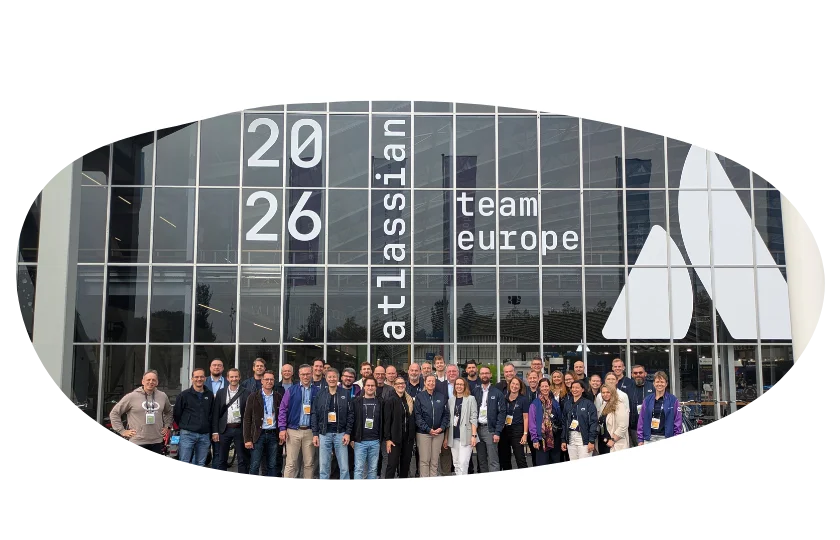
Team ’26 Europe Recap: AI agents become team members
AI agents working alongside humans in Jira, collaborating with people to develop content in Confluence and taking on tasks independently: at Team ’26 Europe, Atlassian demonstrated the future of collaboration.
Key points at a glance
- With AMP, Atlassian turns AI agents into visible, traceable team members in Jira, Confluence and Loom.
- In future, Jira will display all of a team’s agent sessions, whether on-premises or in the cloud. Queries from agents can be answered directly there.
- Rovo is getting a new desktop app and, with Rovo Work, a mode for multi-stage tasks.
- The Teamwork Graph now also understands source code and structured business data.
- With EU AI Inference, AI queries are processed entirely within Europe. The roll-out has begun.
- From 3 December 2026, quotas will apply to Rovo Credits, and automation will be billed per step.
AMP: Atlassian’s framework for collaboration between humans and AI agents
The keynote’s main announcement has a rather technical name: Agentic Multiplayer Protocol, or AMP for short. The idea behind it is easy to explain. Up until now, people have mostly worked with AI assistants on their own. They ask a question, receive an answer and transfer the result to a document or another application. If another person wants to pick up where they left off, they first have to painstakingly piece together the previous context.
AMP is not a single product, nor is it just another chatbot. It is Atlassian’s framework for how people and AI agents collaborate on the Atlassian platform and beyond. It consists of three levels:
- Real-time and asynchronous collaboration: Agents show what they are working on, what they have completed and where they need input.
- Identity and presence: Each agent is recognisable as such, and contributions are clearly attributed.
- Context and governance: Permissions and controls also apply to agents. Important decisions continue to be made by people.
According to Atlassian, there are already over 11 million AMP interactions between teams and agents every month. The following new features in Jira, Confluence and Loom demonstrate how this works in practice.
Jira, Confluence and Loom: People and AI agents working together

Use Loom to easily show what the agent needs to do
Another interesting feature here is the new ‘Record for Agent’ function in Loom. Instead of giving an AI agent a long-winded description of what changes to make, staff simply record their screen and demonstrate the required adjustment. Loom understands what is said, shown and highlighted. This results in a structured prompt with screenshots and acceptance criteria.
In Amsterdam, Atlassian demonstrated this using a website whose design a Figma agent was tasked with modifying. A short screen recording was all it took to explain the task to the agent. ‘Record for Agent’ is part of the new Loom desktop app for Mac and is already in open beta. This is likely to be welcomed by many. After all, it’s often easier to point at something and say “I’d like a change right here” than to formulate a detailed set of instructions. This makes it easier for staff who haven’t had much experience with prompting to get to grips with AI.
Another new feature in Loom is AI Overlays. At the touch of a button, Loom enhances a video with animated titles, highlighted key points, and intro and outro cards. These are based on the transcript and the context from the Teamwork Graph. AMP and Loom thus take the same approach: collaboration with AI is based on ways of working that people are already familiar with. This significantly lowers the barrier to introducing AI-supported processes.
Video code reviews: Interactive PR reviews with Loom
Back to the question from the start: who checks what the agents are doing? In software development, this question is already part of everyday life. When AI agents write a large proportion of the code, reviewing pull requests becomes a bottleneck. Reviewers need to understand what has changed, why, and whether the change is safe. This is where Atlassian comes in with Interactive PR Reviews. Rovo, the Teamwork Graph and Loom automatically generate a short video for every pull request. It shows the change, explains how it was implemented and describes how it was tested. Relevant decisions, such as those from a design document in Confluence, are linked directly.
It’s not just developers who benefit from this. Product management and design teams can also understand the changes from the video and comment directly, without having to read the code. Atlassian is currently testing the feature with selected customers, and it is set to be included in the Teamwork Collection very soon.
Software teams are merely the first to feel the impact of this issue. According to Taroon Mandhana, reviewing the results of AI agents on a large scale will soon become a task in every department. Atlassian therefore aims to provide all employees with the necessary overview so that they can decide whether to accept a result or take a closer look.
Rovo and Artifacts: AI agents carry out tasks autonomously
Teamwork Graph and MCP: Context as the Foundation for AI The Teamwork Graph links organisational knowledge with the relevant context

With so many new features, it’s easy to lose sight of the technology playing an increasingly important role behind the scenes: the Teamwork Graph. It links information from Jira, Confluence and numerous other applications. This enables Rovo to recognise relationships between tasks, documents and decisions, and to take them into account with every query.
At Team ’26 Europe, Atlassian reported that there are now more than 250 billion objects and connections in the Teamwork Graph. Six months ago, the figure stood at 150 billion. More important than the sheer volume, however, is the type of information that Atlassian is now linking together.
Data protection and security: using AI responsibly
Managing AI costs: How much does it cost to work with AI agents?

One question ran through the entire Team ’26 Europe event: How can the costs of AI agents be managed effectively? Individual AI queries have hardly any financial impact. However, when many employees regularly work with various agents that carry out complex tasks involving several steps, the costs quickly add up.
Yet not every task requires the most powerful language model. An example from Atlassian itself illustrates just how significant the potential savings are: last month, the company ran around 3,200 agent runs to generate documentation. An analysis using the Model Fit Score in DX – Atlassian’s app for measuring the productivity of development teams – revealed that for 59 per cent of these tasks, a significantly cheaper model would have sufficed without compromising quality. So anyone using the largest model for every task ends up paying more in over half of the cases.
Atlassian is creating greater transparency with AI Capital Management in the Strategy Collection. Strategy Collection customers can already use these features in the open beta. Managers can see at a glance how AI expenditure is developing in relation to budget and priorities, broken down by model provider, departments, teams and initiatives. Personnel and token costs are displayed side by side. This makes it clear where AI resources are being deployed and how they contribute to the organisation’s objectives.
In many places, organisations are still exploring which tasks can actually be automated. However, as usage grows, cost-effectiveness will quickly become the main focus – from 3 December 2026 at the latest. From that date, fixed quotas will apply to Rovo Credits, and automation will be billed per step executed. Any usage exceeding these quotas will be charged for or paused, depending on your settings. It is therefore worth considering usage, benefits and costs together at an early stage. The key factors here are not only the model price, but also how much time automation actually saves, the quality it delivers and how much human oversight it still requires.
In our webinar ‘Scaling AI without costs spiralling out of control’, we show you how to identify cost drivers and manage your use of AI.
Availability at a glance
What we’ve learnt from Team ’26 Europe
The announcements from Amsterdam clearly show the direction in which Atlassian’s platform strategy is heading. Jira, Confluence, Loom and Rovo are becoming more closely integrated, and AI agents are increasingly taking on tasks within familiar workflows. It is striking how naturally Atlassian views collaboration between people and AI. Agents are visible in Jira, work alongside people on Confluence pages and access the same organisational context.
This may sound like the logical next step in the development of existing AI functions. However, there is a big difference between employees using individual AI tools and these tools actually being integrated into the collaboration process. After all, the difficulty often does not lie in completing a task with the help of AI. It is more challenging to provide the right information, share results with the appropriate people and ensure that everyone involved is on the same page. This is precisely where Atlassian comes in.
It is therefore worth examining these innovations with your own processes in mind. How well is your organisation’s knowledge structured? Are important decisions documented? Can teams find the information they need? And which recurring tasks are particularly suited to collaboration with AI agents? The answers will reveal where suitable use cases lie.
This doesn’t mean the entire organisation has to be overhauled straight away. A good place to start, for example, is a development team that is already working with AI agents and uses Jira for project management. This provides an opportunity to test how well agent sessions fit into existing workflows, what information the agents require, and where tasks can be usefully automated. Drawing on these experiences, you can expand your use of AI step by step whilst also being prepared for when the announced features become generally available.
For us at Communardo, Team ’26 Europe confirms one thing above all: the future of collaboration lies in intelligently connecting people, AI and organisational knowledge. This is precisely what our vision ‘Smarter Together’ stands for. As an Atlassian partner, we’ll support you every step of the way – from structuring your knowledge in Confluence, through establishing clear guidelines for agents, right through to setting up your first pilot team.

Get your Atlassian environment ready for AI agents
Please feel free to arrange a personal, no-obligation consultation with our Atlassian sales experts. Together, we’ll explore which new features from Team ’26 Europe your organisation can already put to good use today.

Your contact person
Marlen KaiserTeam Lead Customer Acquisition
- Kleiststraße 10a, 01129 Dresden
- Tel: +49 351 85033-167
- sales@communardo.de