

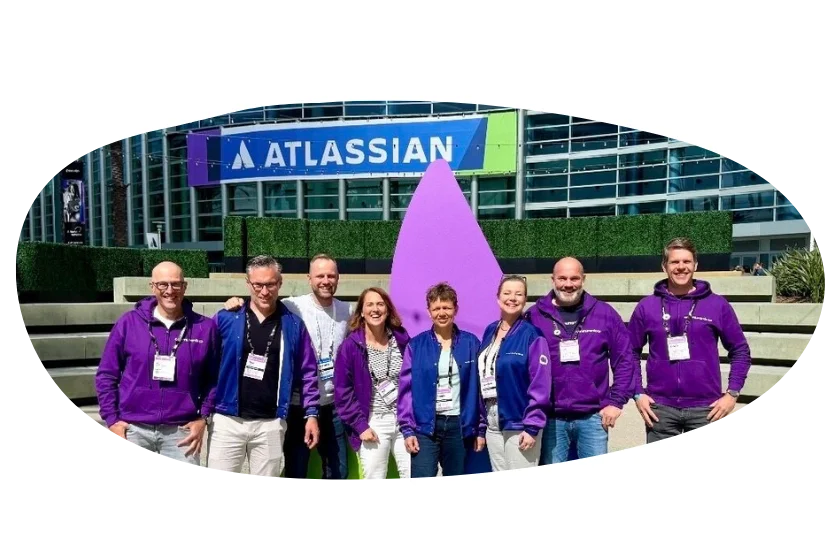
Team '26 Recap: From a productivity tool to an AI-native operating system
Three concepts run like a common thread through the entire conference. Firstly, the Teamwork Graph, the organisation’s ‘nervous system’, which now comprises over 150 billion connections and is opening up to the entire AI ecosystem. Secondly, Rovo Max, the evolution from a simple chatbot to a thinking agent capable of reasoning, planning and autonomously handling tasks. And thirdly, the concept of the AI-native workplace, in which agents act as full team members, processing tickets, understanding code and orchestrating processes.
Atlassian CEO Mike Cannon-Brookes summed it up: “It’s not just about software – it’s about the birth of a new species: the AI-native organisation.”
The Teamwork Graph: From the organisation’s nervous system to its operating system
Anyone who has been following Team ’25 will be familiar with the Teamwork Graph as a data structure that connects tasks, projects, teams and knowledge. This year, Atlassian is taking a decisive step forward: the Teamwork Graph is becoming the operating system of the AI-native enterprise. This development is remarkable. Atlassian is increasing the number of connections from 40 billion last year to over 150 billion – a fourfold increase that forms the basis for all the features demonstrated.
Rovo: From chatbot to autonomous team member

Rovo has evolved from an AI platform into a practical colleague that plans, analyses, acts and learns. The figures demonstrate its widespread adoption: 75% of Fortune 500 companies and 90% of enterprise customers are already using Rovo, with 14 million actions supported each month.
With Rovo Max, Atlassian is taking reasoning to a whole new level. Rovo Max breaks down complex queries into execution plans, accesses the Teamwork Graph, carries out actions and updates results. The entire reasoning process is traceable, ensuring transparency and trust.
Rovo Studio is now generally available and enables users to create specialised agents using natural language and assign them permissions within the Teamwork Graph. You can get started without writing any code, whilst Forge is available for full control. In addition, Rovo Service orchestrates multi-stage workflows across departmental boundaries, such as software provisioning, HR onboarding or employee enquiries. Critical decisions always remain with humans.
Another feature that is likely to make a difference in day-to-day use: Rovo now has both implicit and explicit memory. It learns from the Teamwork Graph, remembers contexts and improves with every interaction. Sessions can be resumed across devices, whether in Atlassian, Slack, MS Teams or Google Gemini.
Agents as First-Class Citizens: When AI Becomes a Team Member
The central theme of the conference was clear: AI agents are team members. In Jira, tickets can be assigned directly to a Rovo agent. These agents update progress, add comments and complete tasks, always with audit logging and clear permissions.
On stage, we saw how agents from Figma, Cursor, Amplitude, GitHub Copilot and Canva work with native integration. Mixed teams comprising humans and AI agents are thus increasingly becoming the norm.
To manage this new ‘AI workforce’ responsibly, Atlassian is providing two new tools. The Agent Inventory offers admins a central dashboard with an overview of every active agent, its creator, its data access rights and its value contribution. AI Pulse complements this with high-level analytics that show how much work is carried out by Rovo compared to humans, whether it be code, resolved tickets or documentation created. This enables data-driven ROI measurement.
Code Intelligence: When AI understands the entire codebase
Semantic code search across 1.5 billion lines of code: Rovo not only understands code, but also the intention behind it, by linking repository data with Jira requirements and Confluence documentation in the Teamwork Graph. The result is a better understanding of the architecture, the identification of outdated components, and the ability to link code directly to individuals and teams. Rovo thus becomes a context-aware advisor for development teams.
Incident Management: From Fire-Fighting to Fire Prevention

Atlassian has fundamentally reimagined incident management and introduced two key tools. The Incident Command Centre has been completely redesigned and offers AI summaries, an incident timeline, root cause analysis, a dependency graph and automatic post-incident reviews in Confluence. The internal results speak for themselves: 80% alert compression, equivalent to 839 engineering hours saved.
But the truly exciting innovation lies in the new Incident Prevention Centre. Rather than merely reacting to incidents, it provides a bird’s-eye view of services and changes prior to deployment, including change risk analysis with financial implications. The focus thus shifts from reaction to prevention.
Dia Browser: The AI-integrated workspace
With the acquisition of the Dia Browser, the browser itself becomes an AI-integrated workspace. Dia understands tabs, context and projects, and is directly linked to the Teamwork Graph. The Morning Brief feature is particularly handy: it analyses the Teamwork Graph overnight and, when you log in, provides a personalised summary of missed Slack conversations, updated Jira tickets and upcoming deadlines. This means you start the day with a clear overview rather than having to catch up manually.
By the way: Dia comes out-of-the-box with SSO, SOC2 Type 2, MDM support and an upcoming Guard integration.
Confluence Slides & Remix: Presentations at the touch of a button
Confluence pages are transformed into professional presentations at the click of a button. What makes this special is that, because Rovo uses the Teamwork Graph, the system knows which diagrams, data points and stakeholders are relevant. It doesn’t just summarise text; it curates content specifically for the target audience.
Security & Governance: Trust in the Age of AI
Atlassian makes it clear that AI without governance is not an option. The new enterprise security features include field-level permissions for granular access control, AI guardrails to define limits on agents’ actions, and agent accounts with their own identities and defined permissions. Every single AI action is recorded in audit logs. Added to this are data sovereignty, a Secure AI Gateway and the aforementioned upcoming Guard integration for the Dia Browser.
Further product highlights

Alongside the major announcements, there were a number of updates that can already make a real difference today. The new Product Collection includes Jira Product Discovery and a feedback app, forming a powerful package for product teams. JSM Enterprise now supports 100,000 agents, and a Virtual Private Cloud is in the pipeline. The Jira integration with Slack and Teams has been enhanced: the Jira Agent in Slack converts discussions directly into work items, including context. In addition, there are deep cross-app AI workflows with Figma, Salesforce, Google Docs, GitHub, DataDog, New Relic, MS Teams and Workday. Finally, Atlassian is consistently positioning cloud migration as “Migration = AI Enablement”: those who move to the cloud unlock the full potential of AI.
What does this mean for you? The added value at a glance
Contextual intelligence rather than generic AI: The Teamwork Graph ensures that answers are tailored to your business context, rather than being generic. This results in 44% more accurate results at 48% lower costs.
Autonomous workflows across departmental boundaries: With Rovo Service and Agentic Workflows, you can automate processes end-to-end, from HR onboarding to software provisioning. Human control remains where it matters most.
An open ecosystem rather than vendor lock-in: Thanks to MCP support and the open Teamwork Graph, you can use your preferred AI tools – such as Claude, Copilot or Cursor – with full Atlassian context. No silos, no isolated solutions.
Enterprise governance for the AI workforce: Agent Inventory, AI Pulse and comprehensive audit logs give you full control and transparency over your AI agents. Measure ROI, manage access and ensure compliance.
From reacting to anticipating: the Incident Prevention Centre and the Morning Brief feature demonstrate that the future belongs to organisations that prevent problems before they arise and identify opportunities before others do.
Our conclusion
Atlassian Team '26 clearly demonstrates that we are moving beyond the traditional, fragmented digital workplace towards an AI-native workplace. Intelligence links an organisation’s collective knowledge and orchestrates processes across team boundaries.
What excites us most about this is that Atlassian isn’t just presenting a vision, but a concrete system that can be used today. From the Teamwork Graph as the foundation, through Rovo as an intelligent assistant, right through to governance tools for responsible use.
Would you like to find out more or start using the new features? Get in touch – we can advise you on the possibilities offered by Atlassian Cloud and support you with implementation.
Your next step
Would you like to know how Atlassian’s new cloud ecosystem can help your business move forward?
Our experts will guide you from the very first workshop right through to a successful implementation – with a practical, collaborative approach and over 20 years’ experience in Atlassian consultancy.